Back to blog home

For years healthcare organizations used outsourced call centers to handle appointment reminders, referral coordination, billing follow-ups, and population health outreach.
It worked…until it didn’t.
Patients expect faster, easier communication. Healthcare organizations are also under pressure to improve access, control labor costs, and grow revenue without adding overhead. Those demands are pushing many teams to look beyond outsourced call centers and toward AI-powered patient communication platforms built for text, voice, and automation.
The shift is not just about replacing calls with text. It is about building a more responsive, measurable way to reach patients and move work forward.
Why Are Outsourced Call Centers Losing Ground in Healthcare?
Outsourced call centers were built for volume. Healthcare now needs more than volume. Organizations need outreach that is easier to personalize, easier to measure, and easier to connect to real workflows. That is where traditional outsourced models often fall short. In many cases, scaling outreach still means paying for more agents, more time, or more vendor support.
There is also a channel problem. Many patients do not want to resolve routine healthcare tasks by answering an unexpected phone call and waiting through a scripted interaction. They want a simpler way to respond when it works for them.
Why Does Texting Change Patient Outreach?

Texting gives patients a lower-friction way to engage with their care team. They can confirm an appointment, respond to outreach, or ask a follow-up question without sitting on hold or navigating a phone tree.
In one JAMA Network Open Study of post-discharge primary care patients, automated text outreach produced response rates that were higher than traditional transition phone calls. For many healthcare organizations, text outreach drives better engagement than phone-first outreach.
That does not mean voice goes away. It means voice works better when used as part of a broader communication strategy. The strongest approach combines text, voice, and automation so patients can respond in the channel that fits the moment.
Healthcare organizations that move beyond phone-first outreach are not abandoning patient communication. They are making it easier to complete.
What Does Modern Outbound Messaging Need to Do?
Replacing a call center requires more than the ability to send bulk messages. It requires outbound communication that can support real healthcare workflows.
That includes appointment reminders, referral coordination, billing follow-ups, care gap campaigns, and post-visit outreach. It also means respecting patient communication preferences and giving organizations flexibility to use text, voice, or both.
A modern outbound system should help teams launch and manage these campaigns in one place, not split them across disconnected vendors or manual processes. It should also make it easier to see what happened after outreach was sent, whether that is a response, a scheduled visit, or a follow-up task for staff.

Case Study – Integrated Spine & Joint Institute
Learn how ISJI slashed phone time by 66% by using OhMD to confirm appointments by text.
How Does AI Automation Support the Front Desk?
Modern patient communication platforms do more than send messages. They help complete the routine work that slows staff down.
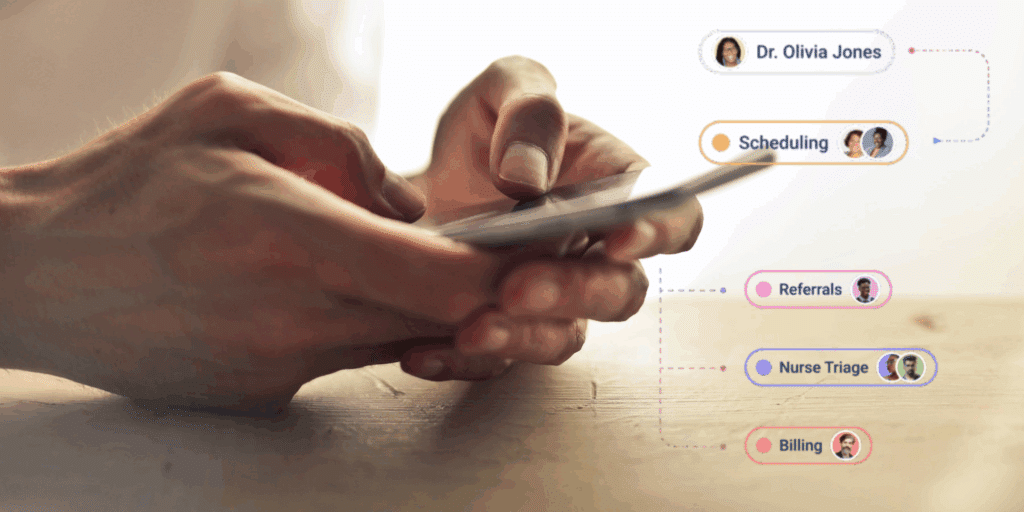
That includes confirming or rescheduling appointments, collecting refill requests, answering common billing questions, routing urgent issues, and triggering the right follow-up at the right time. In the best setups, automation handles the repeatable part of the interaction and staff step in when judgment, empathy, or escalation is needed.
That model matters in healthcare. The goal is not to remove people from the process. It is to remove avoidable manual work so staff can focus on the conversations that need them most.
Unlike outsourced call centers that depend on staffing schedules, automated patient communication can keep working after hours, on weekends, and during peak periods when teams are stretched.
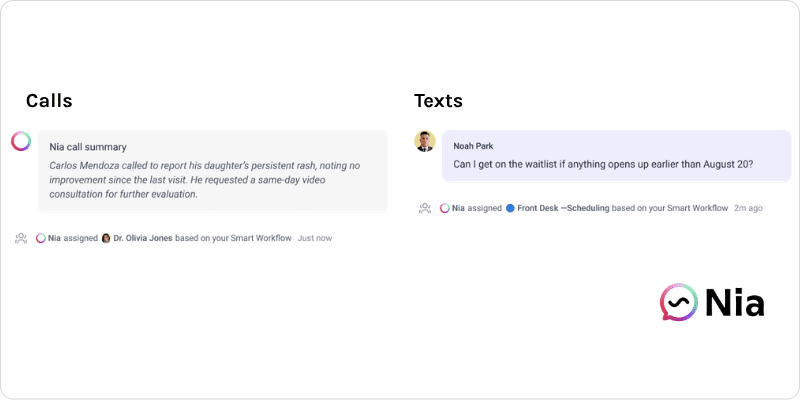
OhMD’s Nia routing incoming patient calls and texts, giving staff time back to provide care
How Can Patient Communication Support Revenue Growth?
Outsourced call centers are often treated as a cost center. A well-designed patient communication platform can do more than reduce costs. It can help protect revenue.
When outreach is easier to launch and easier to track, organizations can improve appointment confirmation, move referrals faster, and stay more consistent with preventive and follow-up campaigns. Automated appointment reminders may help reduce no-shows. Proactive referral outreach may help reduce leakage and improve downstream scheduling.
The operational advantage is visibility. Teams can track response rates, scheduling outcomes, and campaign performance more clearly when communication happens inside one system rather than across a vendor relationship with limited reporting.
Outsourced call center vs AI patient communication platform
Both models support patient outreach, but they operate very differently. Traditional call centers depend on labor and phone-based workflows. AI patient communication platforms combine text, voice, automation, and staff escalation in one system.
| Category | Outsourced call center | AI patient communication platform |
|---|---|---|
| Primary channels | Mostly phone-based outreach | Text, voice, and automated workflows |
| Patient experience | Often depends on a live call connection and agent availability | Patients can respond in a lower-friction way, often on their own time |
| Workflow flexibility | Updates may depend on vendor process and turnaround time | Teams can adjust campaigns, rules, and messaging faster |
| Scalability | Usually scales by adding more labor | Scales through automation across higher patient volumes |
| Visibility and reporting | Reporting may be limited, delayed, or separated from daily workflows | Centralized reporting on responses, outcomes, and workflow performance |
| Staffing model | Depends on agent availability and scheduling | Handles routine tasks automatically and escalates when staff are needed |
| After-hours coverage | May require extra staffing or limited support windows | Can continue routine outreach outside normal business hours |
| Escalation | Escalation depends on scripts, handoffs, and vendor coordination | Routes complex, urgent, or sensitive issues to the right staff member |
| Operational control | Communication is managed largely through a third party | Communication becomes part of in-house operations and workflow design |
Note: The right model depends on your workflows, patient population, and staffing needs. Many organizations use automation for routine outreach and staff for higher-touch conversations.
How Do You Scale Outreach Without Adding Headcount?
Traditional call centers scale by adding labor. Modern patient communication platforms scale through automation.
That changes the economics of outreach. The same system that supports a campaign for 50 patients can support one for 5,000 without requiring a matching increase in staff time. Conversations can run across locations, service lines, and workflows at the same time, while reporting stays centralized.
For healthcare organizations trying to expand access without growing payroll at the same pace, that is a meaningful operational shift.
Where Should AI Handle the Interaction, and Where Should People Step In?
The best communication strategy does not force AI into every interaction. Some vendors position AI as a full replacement for human support. In practice, that can create frustration when the system cannot adapt, answer clearly, or recognize when the issue needs staff attention.
A better model uses AI where it adds the most value and routes to people when the situation calls for judgment. That might mean AI voice for routine outbound calls, AI text for two-way messaging, and human escalation for anything sensitive, complex, or clinically nuanced.
What Changes When Patient Communication Moves In House?
When healthcare organizations move away from outsourced call centers, they gain more control over the patient experience.
They can shape the tone of communication, adjust workflows quickly, and see performance in real time. They can also keep communication inside healthcare-specific, HIPAA-ready systems designed around patient data and team collaboration.
That brings practical advantages:
- More control over messaging and escalation paths
- Better visibility into outcomes and ROI
- More consistent patient experiences across channels
- Faster changes to campaigns and workflows
- Less dependence on outside vendor timelines
The strategic value is simple. Communication becomes part of operations, not a service handed off to a third party.
Why Is Patient Communication Moving to an AI-Native Model?
Healthcare is moving away from phone-based workflows and toward AI-supported, omnichannel communication.
The organizations making that shift are not simply adopting new technology. They are redesigning how patients access care and how staff manage the work that follows. An AI-native patient communication platform can help reduce manual tasks, improve responsiveness, support outreach at scale, and keep teams connected to patients beyond business hours.
Outsourced call centers were built for a different era. Today, healthcare organizations need communication that is more flexible, more measurable, and easier to connect to real patient workflows.
That is why more teams are moving from outsourced call centers to platforms built for text, voice, automation, and continuous engagement.
Frequently asked questions about healthcare call center alternatives
What is a healthcare call center alternative?
A healthcare call center alternative is a patient communication platform that uses text, voice, and automation to handle routine outreach such as appointment reminders, referral follow-up, billing messages, and care gap campaigns. The goal is not to remove staff. It is to reduce manual work and route complex issues to the right people.
Why are healthcare organizations moving away from outsourced call centers?
Many organizations want better visibility, faster workflow changes, and communication that matches how patients prefer to respond. Outsourced call centers can be harder to personalize, measure, and scale without adding more labor.
Is text outreach replacing phone calls in healthcare?
Not completely. Text works well for routine, low-friction interactions, while voice still matters for urgent, sensitive, or complex conversations. The strongest approach usually combines text, voice, and human escalation.
How does AI patient communication help front-desk teams?
AI patient communication can automate repeatable tasks like confirmations, rescheduling, refill routing, and basic billing follow-up. That frees staff to focus on patients who need judgment, empathy, or live support.
Can a patient communication platform help reduce no-shows and referral leakage?
It can support those goals by making reminders, follow-up, and referral outreach more consistent and easier to track. Results depend on workflow design, patient population, and how well teams follow through.
What changes when patient communication moves in house?
Organizations gain more control over messaging, workflows, escalation paths, and reporting. Communication becomes part of daily operations instead of a service managed mainly through a third-party vendor.
When should AI hand off to staff in healthcare?
AI should handle routine, rules-based interactions and hand off when an issue is sensitive, clinically nuanced, urgent, or confusing. A good system makes that escalation easy and visible.

Ready to talk to an AI expert?
Learn more about AI-powered patient communication and how Nia can help your practice same time and money.